AI TOOL / #07259
Lunit
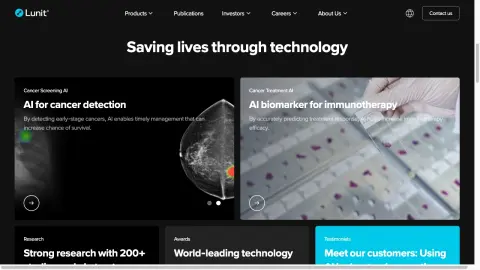
Lunit develops medical artificial intelligence technologies for the early detection of cancer and the optimization of treatment methods.
Introduction
Lunit develops medical AI for early cancer detection and treatment optimization.
What is Lunit?
Lunit is a public company that develops medical artificial intelligence software to help fight cancer. Their AI solutions focus on early cancer detection and the optimization of cancer treatments. Lunit INSIGHT is capable of accurately identifying abnormal radiological findings in chest X-rays, often detecting abnormalities that are invisible to the human eye. Lunit SCOPE uses artificial intelligence to predict patients’ responses to treatment, enabling doctors to make more informed decisions regarding patient care.
How to use Lunit?
Visit the Lunit website to explore their artificial intelligence solutions, including Lunit INSIGHT for radiology and Lunit SCOPE for oncology. Get in touch with them to learn more about how you can integrate their AI technologies into your medical practices or research efforts.
The core functions of Lunit
Artificial intelligence-based cancer screening and diagnosis
Predicting treatment responses based on artificial intelligence
It exhibits high precision in detecting radioactive abnormalities.
Provide solutions for radiology and oncology.
Related
Visus.ai
Train your ChatGPT AI using your own documents and knowledge base.
Zecoba AI Chat
Affordable, on-demand access to GPT4 and AI-powered drawing tools, available from both OpenAI and Midjourney.
Boundless AI
Unbounded AI: A platform that provides enterprises with customized chatbots.
ChaptersAI
The GPT client designed for branched conversations is ideal for complex projects and in-depth analyses.
Meoria
Meoria is a free AI-powered ap...
Whizi
Whizi is an AI center that boasts over 200 different AI models, including ChatGPT, Claude, and Stable Diffusion.